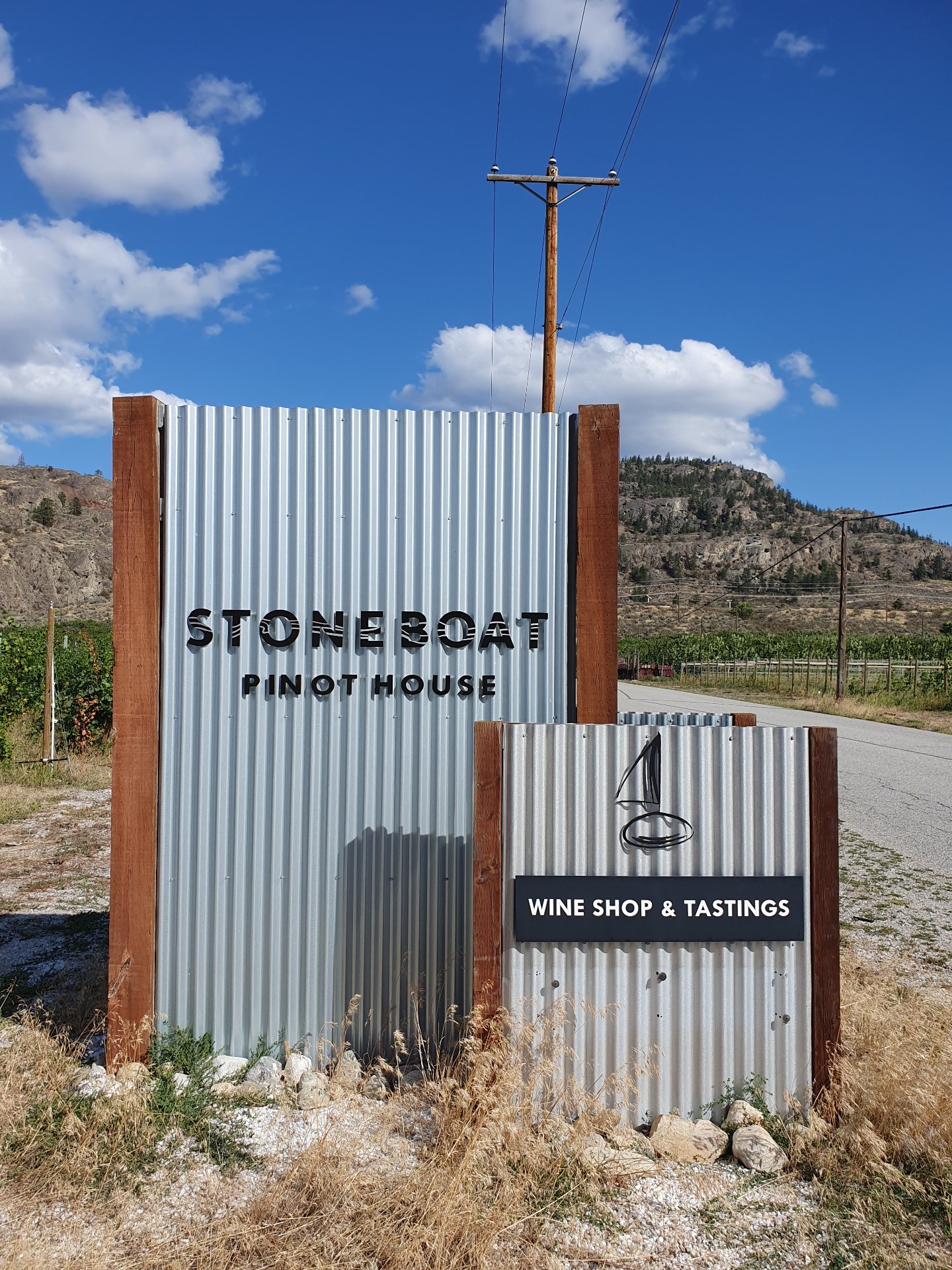
When exploring Stoneboat Vineyards Oliver, to explore the quality wine scene in Oliver, I visited Stoneboat Vineyards and spoke with winemaker William Adams.

The Stoneboat Vineyards Oliver winery was originally founded by Lanny Martinuk in 1979, when he moved with his family from Vancouver to Oliver with a simple goal: to grow grapes and make wine. The land had previously been planted with fruit trees, which Martinuk removed as he began experimenting with viticulture. Early progress was slow. Harsh winters repeatedly destroyed young vines, and the soil — full of large stones — made vineyard work difficult. Nearly a decade passed before the vineyard started producing promising results. The first commercial vintage was eventually released in 2005.

The Stoneboat Vineyards Oliver estate lies on the Black Sage Gravelbar, a flat terrace of sandy soils mixed with gravel and stream deposits. These conditions suit pinot varieties, which became the winery’s identity. Pinot noir is the primary grape grown here, well adapted to the region’s cooler nights despite hot summers. The winery also cultivates pinot gris and the more unusual red variety pinotage, a cross between pinot noir and cinsault originally developed in South Africa. Because of this focus, Stoneboat often refers to itself as a “Pinot House.”

For many years the winery also produced icewine from pinotage, but production stopped after 2019 due to the intense labour and cost involved. Harvesting and pressing frequently took place outdoors in freezing temperatures during the holiday season — sometimes even on Christmas Eve.

Today Adams focuses on wines that express the character of the vineyard: sparkling pinot blanc made using the tank method, aromatic whites from riesling and pinot gris, and lighter red wines from pinot noir and pinotage. Vineyard intervention is kept to a minimum. The team aims to farm as organically as possible, avoiding pesticides and chemicals, and even relying on ladybugs as natural pest control in the vines.
Growing grapes in Oliver is not easy. The region’s desert climate brings scorching summers and a constant risk of wildfires — including a devastating fire season in 2023. Extreme cold is another major threat. Severe winter freezes in December 2022 reduced yields by about 58%, and an even harsher cold spell in January 2024, when temperatures dropped well below −20 °C for several days, caused widespread vine death across the Okanagan Valley. Many vineyards lost up to 80% of their vines and had to replant, a process that can take at least three years before production resumes.

Because of this damage, many wineries in Oliver — including Stoneboat — had to purchase grapes from Washington for the 2024 vintage. Wines made from these grapes cannot carry the provincial VQA designation, although the government temporarily allowed wineries to import grapes from Washington, Oregon, and Ontario to help the industry recover.
Despite these challenges, Stoneboat remains an important pioneer of Oliver’s wine scene. The estate covers about 4.8 hectares of vineyards and produces roughly 72,000 litres of wine annually (around 8,000 cases). Martinuk retired in 2021, and the winery is now owned by two former professional athletes who continue his vision, with Adams leading the winemaking.

The name Stoneboat refers to the sled-like tool once used to drag heavy stones across fields — exactly the kind of equipment Martinuk needed when he first began clearing the rocky land that would eventually become this vineyard.
Understanding Stoneboat Vineyards Oliver
See also: Okanagan Valley wine scene
See also: BC Wine Institute
See also: Official Kelowna and Okanagan Tourism
See also: Stoneboat Vineyards