Phantom Creek Estates: A New Standard of Luxury and Precision in the Okanagan Valley
“A world-renowned winemaker from France, a chef from a Michelin-starred restaurant in New York City, a 500-seat amphitheater, and a private tasting room with a Chihuly sculpture overhead — it sounds like another Tuesday in Napa. But Phantom Creek Estates has brought this same sense of luxury and ambition to Canada’s Okanagan Valley.”

That is how Adam Morganstern opened his Forbes article about Phantom Creek Estates in 2021, and the comparison is not accidental. The winery represents something new for the Okanagan: a bold, uncompromising vision that blends world-class winemaking with architecture, art, and luxury hospitality.

Yet the story of Phantom Creek Estates did not begin with a grand winery building. It began in the vineyards.

The Becker Project: Where the Story Begins
The foundation for what would eventually become Phantom Creek Estates was laid in 1977 with the Becker Project. German researcher Helmut Becker conducted a groundbreaking viticultural experiment in the Oliver area, planting roughly thirty different European grape varieties in the Okanagan Valley.
The project proved something crucial: Oliver’s climate and soils could successfully grow classic European red grapes. What had once been considered a risky idea suddenly became a viable future for the region.
Today, the site where Becker conducted his research is known as Becker Vineyard, and it remains one of the most historically significant vineyard sites in the valley.
Harry McWatters and the Bordeaux Vision
In 1993, Canadian wine pioneer Harry McWatters recognized the enormous potential of the Becker site. McWatters had already established himself as a major force in the Okanagan wine industry when he founded Sumac Ridge Winery in Summerland in 1979.
Seeing the quality of the land near Oliver, he began planting classic Bordeaux varieties there — Merlot, Cabernet Sauvignon, and Cabernet Franc, with Syrah added later. His instincts proved correct. The site produced wines with remarkable structure and consistency, helping to establish Oliver as one of the most serious red-wine regions in Canada.
McWatters remains widely regarded as one of the founding pioneers of the modern Okanagan wine industry.

Discovering Phantom Creek Vineyard
Another key moment came in 1996 when viticulture expert Richard Cleave identified Phantom Creek Vineyard as an exceptional site for growing premium wine grapes.
Unlike a winery, a vineyard is simply the land where the grapes are grown. And Phantom Creek Vineyard quickly gained a reputation as one of the finest vineyard locations in Canada, capable of delivering consistent fruit quality year after year.
A third major vineyard site, Kobau Vineyard, was planted in 2005, further strengthening the estate’s vineyard portfolio.
In other words, the foundation of Phantom Creek Estates was built the right way: vineyard first, winery later.
The Birth of Phantom Creek Estates
The modern chapter began in 2016 when entrepreneur Richter Bai, a businessman from China and a passionate collector of Bordeaux wines, purchased the vineyards.
His vision was ambitious: create a world-class winery in Oliver that could rival the most prestigious wine destinations in the world.
That vision became reality when Phantom Creek Estates officially opened in 2020.
A Winery Unlike Anything Else in the Okanagan
Phantom Creek Estates is not simply a winery — it is a destination.
The estate features a striking modern building overlooking the valley, luxury tasting spaces, a high-end restaurant, private rooms for VIP guests, extensive cellars, and even hidden rooms rumored to house the owner’s private art collection.
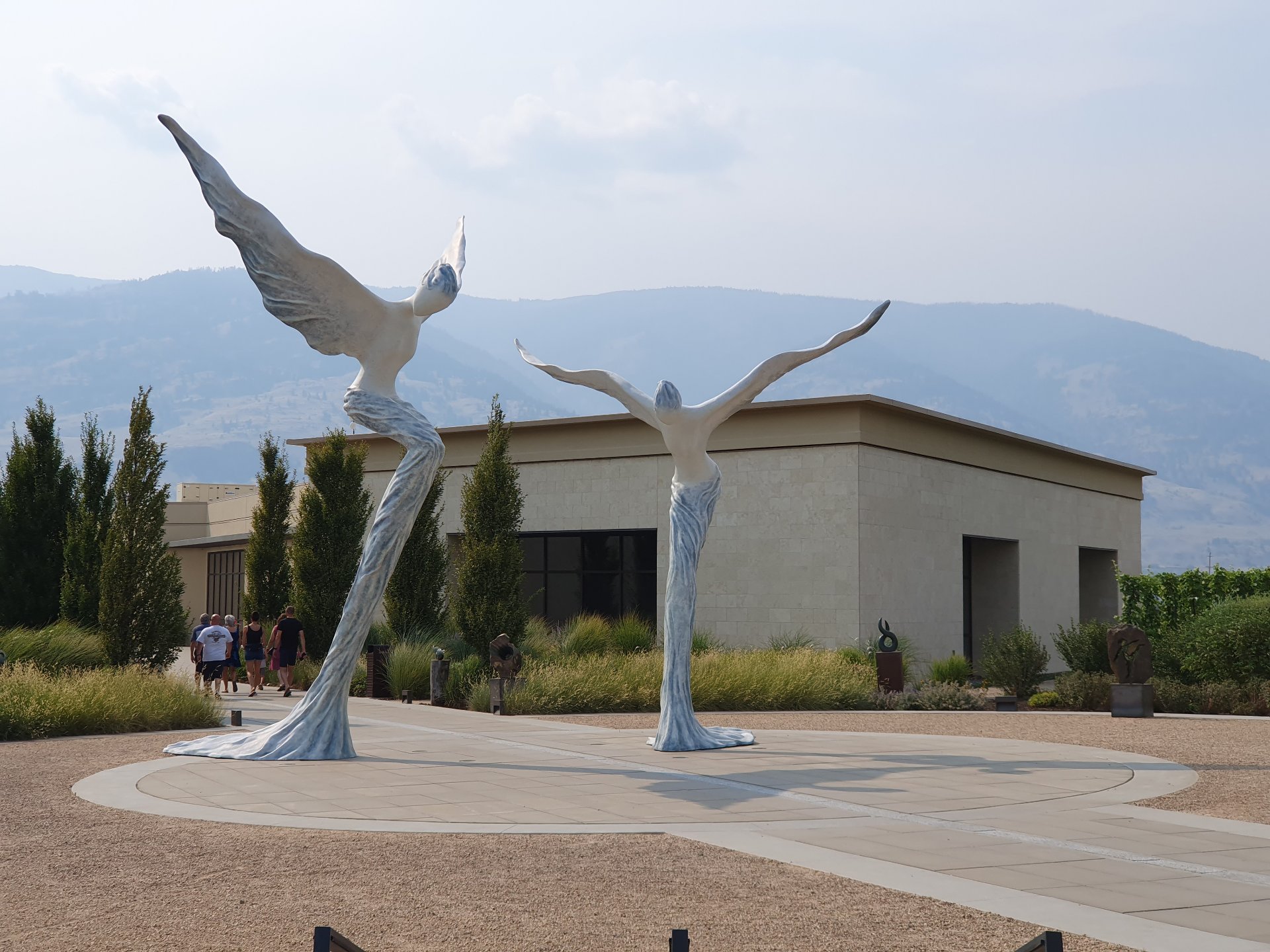
Visitors arriving at the estate are greeted by a dramatic seven-meter sculpture titled “Pro Terra et Natura.” Inside, the architecture is equally striking. The building itself incorporates limestone imported from the Giza region of Egypt — a symbolic connection to the enduring materials used in ancient pyramids.
Art plays a major role throughout the estate, reflecting the owner’s belief that wine, architecture, and art should exist in conversation with one another.
Organic Certification and Biodynamic Philosophy
In 2021, Phantom Creek Estates received organic certification from Ecocert, one of the world’s leading certification organizations.
But the shift toward sustainability started earlier. Since 2017, the estate has been implementing biodynamic farming principles, aiming to strengthen vineyard health and promote a more balanced ecosystem.
All grapes are hand-harvested, and only the best clusters are selected.
One of the winery’s key philosophies is to harvest earlier than many other producers in the region, preserving freshness, acidity, and vibrancy in the finished wines.

Gravity-Flow Winemaking
The winery’s production facility was designed around a gravity-flow system, allowing grapes, juice, and wine to move naturally through the building without aggressive pumping.

Three vertically arranged production levels guide the wine through the process. Automated juice transfer systems move the wine gently between stages, minimizing mechanical intervention and preserving delicate flavors.
The architectural design itself is intended to protect wine quality at every step.
A World-Class Winemaking Team
Phantom Creek Estates has assembled an impressive international team.
Mark Beringer, Director of Winemaking, comes from one of the most famous wine families in California. He is the great-great-grandson of Jacob Beringer, who co-founded Beringer Vineyards in Napa Valley in 1876. He started the winemaking team at Phantom Creek Estates, however he is no longer associated with the winery. The director of winemaking today is Jean-Marc Enixon.
The estate also works with renowned Alsace winemaker Olivier Humbrecht of Domaine Zind-Humbrecht as a consulting winemaker.
This blend of global expertise and local terroir is central to Phantom Creek’s philosophy.
Betting on Syrah
One of the most fascinating aspects of the estate’s viticulture is its commitment to Syrah.
After the extreme cold spell in January 2024, many winemakers in the Oliver region began questioning whether Syrah could continue to survive Okanagan winters. Some even suggested that the grape might disappear from the valley altogether.
At Phantom Creek Estates, however, the outlook is more optimistic.
The estate’s Syrah vines appear to have survived the cold remarkably well, giving the team confidence that the variety still has a future here.
Production and Winemaking
Phantom Creek Estates produces approximately 450,000 liters of wine annually, equivalent to around 50,000 cases.
White wines are pressed slowly and fermented with wild yeast in large Austrian foudre barrels. Fermentation times are intentionally long, allowing the wines to develop depth and texture.

The wines are neither fined nor filtered, reflecting a low-intervention philosophy aimed at preserving purity and character.
Red wine production is even more meticulous.
Fermentation takes place in oak vats produced by Tonnellerie Rousseau, one of the most respected cooperages in the world. After fermentation, the wines are pressed using a Diemme vertical basket press, a traditional and labor-intensive method believed to produce softer tannins and more elegant textures.

The wines then age quietly in barrel for 18 to 20 months.
Only the finest cooperages are used, including Saury and Taransaud, both internationally recognized for producing exceptional oak barrels.
A New Era for the Okanagan?
Phantom Creek Estates stands in sharp contrast to many of the smaller, more understated wineries of the Okanagan Valley. Where some producers emphasize modest scale and rustic charm, Phantom Creek embraces ambition, scale, and international prestige.

For some observers, the estate represents something larger — perhaps the beginning of a “Napa-style” reputation for the Okanagan Valley.
Whether that vision fully materializes remains to be seen. But one thing is clear: Phantom Creek Estates has already raised the bar for what a winery in the Okanagan can be.
With its combination of world-class vineyards, cutting-edge winemaking, sustainability, and architectural grandeur, it has positioned itself as one of the most remarkable wine estates in Canada.

See also: Okanagan Valley wine research
See also: Stoneboat Vineyards
See also: Stoneboat Vineyards in Oliver
See also: BC Wine Institute
See also: Phantom Creek Estates